
This morning dawned bright and unseasonably warmly. The work load was light and gave me ample time to cheer for my students as they ran relays, accompanied by upbeat classical songs like the overtures from William Tell and the Marriage of Figaro blasted over the outdoor speakers.
"That music is such a good idea," I commented to no one in particular while indulging in a little aimless hand waving and finger tapping.
"Yes," a teacher agreed. "It's to keep the kuma away."
"Good idea!" I enthused, by now entirely lost in my imaginary orchestra conducting. Meanwhile in my head the word "kuma" sifted lazily through my translation filters until it finally nudged the word "bear" and stuck fast. "Wait....what?"
I watched the children playing outside with somewhat more focus while the teachers filled me in. Apparently our little area has had several shaggy, clawed visitors lately. Earlier this week one surprised an elderly couple, breaking the wife's ankle and raking half of the husband's face away. Early yesterday morning another--or the same one, who knows?--broke a window and climbed into a nearby junior high school. Then today another (NOT the same one, as the last one was shot in the school) was spotted in the middle of the afternoon ambling around the middle of town. The parents have all become busy mockeries of the "green movement", with their cars constantly roaring to life only to be quieted a block or sometimes two later, where they drop off their kids and promise to pick them up any time they call, no matter how inconvenient. Then the night comes, and few people leave their houses at all.
"But," said Mogi-san, ever practical, "at least bear meat is delicious."
Thursday, October 14, 2010

Saturday, September 18, 2010
Kendo & Kyudo
I've never been fond of spiders--are any of you surprised? But when I say I'm "not fond" of spiders, I mean that I will leap inhuman distances to avoid their paths. When the kids at school ask me what I like I respond with things like snakes, rain, and frogs; but when they ask me what I don't like I simply make a scuttling motion with my hands and shudder. Words fail me.
Unfortunately for me, Japan is full of spiders, and the only trait they all have in common is that they will not take "shoo" for an answer. There are the microscopic ones that fill my bathtub with invisible threads whenever I don't use it for a few days; the fat ones that hang just above my head when I open the apartment door; and the dark ones that lurk in the branches of the trees. But Friday I noticed a new kind as I drove home from school. Oh yes, you read that right: these spiders are big enough to be viewed from a moving vehicle. They are bright acid green and they have built correspondingly huge webs that stretch across power lines. What does a spider need with a power line?? For all I know they bide their time catching and devouring birds while they impatiently wait for someone to walk beneath so they can plunge down from above like terrible green avengers.

So you can see why my only recourse was to embrace the white-kid-in-Japan stereotype and start taking martial arts classes.
I signed up for both kendo (sword-fighting) and kyudo (archery) and went to both classes for the first time yesterday. Both my teachers are men with the patience of saints, and we quickly established a predictable pattern of me dropping something (swords, arrows, gloves--you name it, I dropped it), staring at the offending article for a bitter moment, and finally stooping to pick it up with a, "Sumimasen" ("excuse me"). Meanwhile both teachers nodded kindly and told me I was doing fine--by the end they were doing it so often they looked like bobble heads.
Both kendo and kyudo are very artistic. Everything matters; you must constantly be aware of where your eyes are, where your fingers are, which foot is in front and how far in front it is. When the teachers perform they make it all look simple and fluid and somehow still deadly. My attempts, on the other hand, are predictably labored and choppy. I imagine that if I actually had to use these skills in any sort of battle the inner monologue would run something like this:
"Alright, I've got this. K. Hold the arrow in the left hand, pause, look at target. Wait, dang, are my fingers at the right height?? NO! DANGIT! Wait..wait, okay, got it we're good. Whew. Draw right hand into position on the bowstring. Wait, is my posture correct? Make a circle with your arms, girl! Why do you always forget the circle!!! K. Look at target. Raise arms and bow above head...and....oh shoot just dropped the arrow again!! Oh no wait...there it is! Funny, I don't remember aiming at my own chest...Oh."
Luckily in kyudo all the other students are kind and sparing with their laughter. Even more luckily, in kendo I get to practice with the kids, which gives me an excuse to gallop around yelling, "Kyaaaaaaaah!" with them like an overgrown Karate Kid reject. The kids are only too willing to laugh at my mistakes, but it's impossible to take anything offensively from a 3-foot-tall stranger shrouded in formal kendo armor, nothing showing but a head of spiky hair and huge dark eyes over an impish grin. It also helps that they are exuberantly inclusive; clearly it doesn't matter to them how well I do something, as long as I just do. And that makes it very fun.
Soon I may be able to do actual bodily harm, but in the meantime I am capable of very intimidating charge and some fancy bow-holding. Look out, world!
Unfortunately for me, Japan is full of spiders, and the only trait they all have in common is that they will not take "shoo" for an answer. There are the microscopic ones that fill my bathtub with invisible threads whenever I don't use it for a few days; the fat ones that hang just above my head when I open the apartment door; and the dark ones that lurk in the branches of the trees. But Friday I noticed a new kind as I drove home from school. Oh yes, you read that right: these spiders are big enough to be viewed from a moving vehicle. They are bright acid green and they have built correspondingly huge webs that stretch across power lines. What does a spider need with a power line?? For all I know they bide their time catching and devouring birds while they impatiently wait for someone to walk beneath so they can plunge down from above like terrible green avengers.
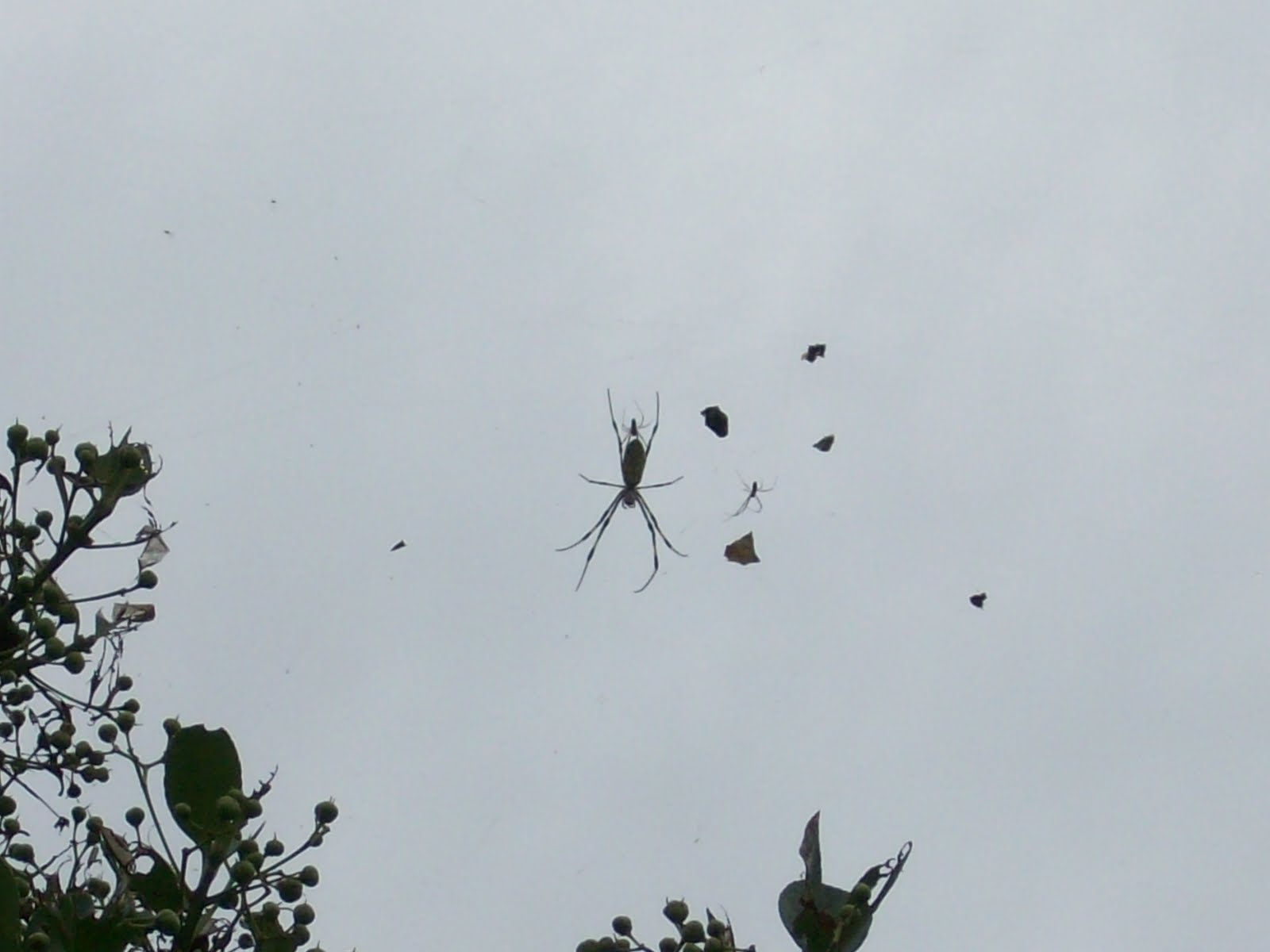
So you can see why my only recourse was to embrace the white-kid-in-Japan stereotype and start taking martial arts classes.
I signed up for both kendo (sword-fighting) and kyudo (archery) and went to both classes for the first time yesterday. Both my teachers are men with the patience of saints, and we quickly established a predictable pattern of me dropping something (swords, arrows, gloves--you name it, I dropped it), staring at the offending article for a bitter moment, and finally stooping to pick it up with a, "Sumimasen" ("excuse me"). Meanwhile both teachers nodded kindly and told me I was doing fine--by the end they were doing it so often they looked like bobble heads.
Both kendo and kyudo are very artistic. Everything matters; you must constantly be aware of where your eyes are, where your fingers are, which foot is in front and how far in front it is. When the teachers perform they make it all look simple and fluid and somehow still deadly. My attempts, on the other hand, are predictably labored and choppy. I imagine that if I actually had to use these skills in any sort of battle the inner monologue would run something like this:
"Alright, I've got this. K. Hold the arrow in the left hand, pause, look at target. Wait, dang, are my fingers at the right height?? NO! DANGIT! Wait..wait, okay, got it we're good. Whew. Draw right hand into position on the bowstring. Wait, is my posture correct? Make a circle with your arms, girl! Why do you always forget the circle!!! K. Look at target. Raise arms and bow above head...and....oh shoot just dropped the arrow again!! Oh no wait...there it is! Funny, I don't remember aiming at my own chest...Oh."
Luckily in kyudo all the other students are kind and sparing with their laughter. Even more luckily, in kendo I get to practice with the kids, which gives me an excuse to gallop around yelling, "Kyaaaaaaaah!" with them like an overgrown Karate Kid reject. The kids are only too willing to laugh at my mistakes, but it's impossible to take anything offensively from a 3-foot-tall stranger shrouded in formal kendo armor, nothing showing but a head of spiky hair and huge dark eyes over an impish grin. It also helps that they are exuberantly inclusive; clearly it doesn't matter to them how well I do something, as long as I just do. And that makes it very fun.
Soon I may be able to do actual bodily harm, but in the meantime I am capable of very intimidating charge and some fancy bow-holding. Look out, world!
Sunday, September 5, 2010
Party Weekend
The nice thing about living in the middle of nowhere in a country where you don't speak the language is that it is ridiculously easy to fall into new experiences. For instance, you might hear your coworkers mention "dance" and "festival" in the same conversation, and all you would have to do is ask if there was a festival nearby and they would take care of the rest--meaning that they would volunteer you to dance in said festival, in front of hundreds of people, with no prior practice with the dance itself.
That's how I ended up in a tiny room, struggling into a yukata (it takes a LOT of work to wear something that is basically just a cotton robe). The problems began with my feet: they were significantly bigger than anyone else's and wouldn't fit into the required decorative slippers (zori). Luckily I'd foreseen this and brought my own geta (wooden clogs of a sort). However, this meant that while everyone else was padding along on thick pieces of foam I was clunking around in big blocks of wood tied loosely onto my toes. The yukata itself doesn't encourage much movement by binding your legs tighter than a sleeping bag, and the wide sash around the waist (obi) is reinforced with cardboard so you can forget about bending any part of your midsection. And this was my dancing uniform.
Luckily the dance was easy; I was able to get it relatively down after a few repetitions, even without any practice. It was all mostly in the hands: in one hand I held a fan, which I was supposed to move in graceful patterns while shuffling my feet forward. The fans had little numbers on them and at the end of the dance our numbers were part of a lottery; I won a box full of absolutely massive purple grapes (and yes, I do intend to eat the skins). It was incredibly fun. I love the Japanese attitude towards celebrations; that is, that everyone should participate regardless of age, status, or skill.
And that attitude was never more fully demonstrated than the next morning, when I went to a sports festival (undokai) at my smallest school. The school only has 8 students total, so the school invited the entire community to take part in the festival. Toothless grandmas and grandpas, bent nearly double from years of toiling in rice fields, ran sprightly relays around the track. Teachers, devoid of their usual suits and somber expressions, pitted their strengths against each other in huge tug-of-wars. The kids showed off their tumbling and unicycle skills. It was nice to be able just joke around and bond with the kids, and the shy ones started to open up as we cheered on their family members and talked about sundry things in a mixture of Japanese and English.
After that I visited the castle in Kaminoyama. It was like all the other castles I've seen in Japan: a single white tower. The rest of the structure is almost always destroyed, whether by paranoid shogun or the ravages of fires and earthquakes. Even the tower is typically a reconstruction. Still--and this should come as a surprise to none of you--the gardens are always superb. I sat at the edge of their pond and watched the obese fish struggle by until the sinking sun and a noisy group of teenagers finally drove me away.
A good weekend all around. :)
Wednesday, August 25, 2010
And I Don't Peel My Potatoes, Either.
Today I had to give a demonstration class in one of the schools, to show myself off like a shiny appliance with all sorts of newfangled features and hope the result is that the school decides to keep me around (at least until the warranty expires). It was set up just like an normal day in class, but the teachers played the parts of the students. I played the part of the enthusiastic cheerleader, and we were off on a whirlwind adventure of classroom games and stilted English (mostly on my part. Go figure). It felt exactly like a roller coaster experience: terrifying and entirely unsettling...until the ride stops and you're suddenly flooded with a surge of exhilaration that convinces you that that was F-U-N.
As a reward, the principal gave me some muscat grapes. K, not really, everyone got them, but I wanted them most so I think that counts. I devoured them as quickly as I could with both hands because it was (yet again) brutally hot and these were FRIDGE grapes, cool enough to savor if I could just get them into my mouth before the sunlight and humid air had time to settle on them. But even in the height my grape-snatching frenzy I couldn't help but notice that the principal was not eating the whole grape: he was delicately separating fruit from skin, leaving a pile of discarded green flesh on his plate. He noticed my own indiscriminate tastes at the same time, and good-naturedly informed me that I was the odd one in this scenario. Then he called in his vice-principal and in Japanese told her, "Look, she eats the skins!" Looking amused, they proceeded to ask me if Americans also devour the shells along with our nuts. "Of course not!" I replied. But then I sort of ruined the effect by letting them know that I used to try to eat their soy beans (edamame) by gnawing through the furry outer pod.
Lasting Impression Tally:
Nifty Teacher: 0
Manic Foreigner with the Table Manners of a Squirrel: 1
Trip Recap
Kanazawa
One of the most delightful aspects of Kanazawa is its dedication to preserving historical areas in the middle of the city, so visitors can easily walk from a posh shopping district straight into narrow, walled streets of samurai houses, several of which are still lived in. A few souvenir shops sprinkle the area, selling sweets with gold in them. A few of the houses are open to the public, and it is well worth it to see the gardens. The inner rooms of Japanese buildings are all predictably similar, whether you're viewing a humble soldier's home or a lord's: tatami mats, sliding doors, displayed instruments, and a family shrine or two. The true indication of a family's status is the loving care that has been put into the garden; and boy, is it worth seeing! Meticulously landscaped streams, banks rich with green moss and old sculptures, miniature trees and blissfully over-fed koi fish that have to struggle just to edge themselves under the tiny foot bridges. Even now, the same level of care is maintained in Kanazawa's public gardens; as I learned when I visited Kenrokuen and saw the caretakers shrouded from chin to toe to ward off sunburns after spending almost an hour hunched over the same patch of moss.

I also got to walk around a geisha house, which looked just like the samurai house but with more instruments and fewer suits of armor. In the geisha district they specialize in making delicate, sculptured sweets out of a sort of gumpaste. They are glorious to behold and not so much to taste.
I also visited a temple that was full of secret passageways and 2 whole floors that were invisible from the outside of the building. The lord of the area, fearing an attack on the castle, fortified the outer temples with hidden weapons and samurai, who could watch the visitors to the temple from behind dark bamboo slats in the doors of closets that were angled to work like one-way mirrors. Even the collection box was a trap; it had no bottom, only a steep plunge into the basement awaiting anyone who was unfortunate enough to be pushed over the edge while making a charitable offering. And, if all should go wrong, it also had a suicide chamber with 4 tatami mats (4 being the number of death) and a self-locking door that would prevent cowards from changing their minds and fleeing once they were inside the room.
None of these enhancements were noticeable at first glance, and I think that goal was furthered by the enormous, attention-stealing gold altar in the center. It was very reminiscent of the displays you can find in any catholic church, and I was just musing on the similarities between religions worldwide when my eyes settled on the offering plates, stacked high with boxes of Ritz crackers and Pocky candy (biscuit sticks covered in chocolate). So alright, maybe not that similar, but I like their style! ^__^
Osaka
In Osaka, everything’s bigger. The food. The ferris wheels. The aquariums—2,000 tons of seawater bigger, to be exact, and housing several otters, porpoises, and two whale sharks whose wide, placid grins occupied me for hours. And while I wasn’t staring at ginormous fish, I was bathing in a mosque or sinking my arms deep into a stone urn full of green, medicinal mud in Bali—or at least appeared to be, thanks to the interior designers at Spa World.
I took daytrips out from the city, as well. I saw an art museum in Kobe displaying the works of the artist responsible for Gegege no Kitaro; he had to learn to re-draw everything after losing his dominant arm and it was amazing to see the intricacy of his ink illustrations. In Kyoto I saw Kinkakuji, the temple entirely plated in gold leaf, which draws so many tourists during this season that the garden overlooking the temple becomes a sea of sticky flesh. It is every bit as unappealing as it sounds--the tourist aspect, that is. The temple itself was lovely. And in Koka, a little village with only a small train station to advertise its existence, I saw one of the last remaining ninja houses. Evidently they have few problems with vandalism or theft, since I was allowed to climb through secret attics and examine self-locking windows that could only be opened with a slip of paper, revolvers hidden in short knife handles, and rotating walls. I even tried my hand at throwing the shuriken (ninja stars), and failed at hitting the target so epically that the man who trained me could only laugh.
And now, a sidenote:
Japanese sweets are, more often than not, nothing more than a trap for the Western tourist. The Japanese have perfected the aesthetic quality of their desserts and even the simplest ones are like works of art, with delicate colors, textures, and patterns. However, if you should try one of these enticing beauties, you will find the taste (and calorie content) to be akin to that of a plain sheet of paper. The Japanese have no appreciation for butter or even the crowning ingredient itself: sugar. So what happens when America gets its feisty capitalist fingers into the Osaka pie?
One of the most delightful aspects of Kanazawa is its dedication to preserving historical areas in the middle of the city, so visitors can easily walk from a posh shopping district straight into narrow, walled streets of samurai houses, several of which are still lived in. A few souvenir shops sprinkle the area, selling sweets with gold in them. A few of the houses are open to the public, and it is well worth it to see the gardens. The inner rooms of Japanese buildings are all predictably similar, whether you're viewing a humble soldier's home or a lord's: tatami mats, sliding doors, displayed instruments, and a family shrine or two. The true indication of a family's status is the loving care that has been put into the garden; and boy, is it worth seeing! Meticulously landscaped streams, banks rich with green moss and old sculptures, miniature trees and blissfully over-fed koi fish that have to struggle just to edge themselves under the tiny foot bridges. Even now, the same level of care is maintained in Kanazawa's public gardens; as I learned when I visited Kenrokuen and saw the caretakers shrouded from chin to toe to ward off sunburns after spending almost an hour hunched over the same patch of moss.

I challenge you to look at that picture and NOT be reminded of those dancing mushrooms from Disney's Fantasia.
And what were they doing? Picking up leaves and other debris from the ground so the moss could be viewed in its naked glory. Wow.
I also visited a temple that was full of secret passageways and 2 whole floors that were invisible from the outside of the building. The lord of the area, fearing an attack on the castle, fortified the outer temples with hidden weapons and samurai, who could watch the visitors to the temple from behind dark bamboo slats in the doors of closets that were angled to work like one-way mirrors. Even the collection box was a trap; it had no bottom, only a steep plunge into the basement awaiting anyone who was unfortunate enough to be pushed over the edge while making a charitable offering. And, if all should go wrong, it also had a suicide chamber with 4 tatami mats (4 being the number of death) and a self-locking door that would prevent cowards from changing their minds and fleeing once they were inside the room.
None of these enhancements were noticeable at first glance, and I think that goal was furthered by the enormous, attention-stealing gold altar in the center. It was very reminiscent of the displays you can find in any catholic church, and I was just musing on the similarities between religions worldwide when my eyes settled on the offering plates, stacked high with boxes of Ritz crackers and Pocky candy (biscuit sticks covered in chocolate). So alright, maybe not that similar, but I like their style! ^__^
Osaka
In Osaka, everything’s bigger. The food. The ferris wheels. The aquariums—2,000 tons of seawater bigger, to be exact, and housing several otters, porpoises, and two whale sharks whose wide, placid grins occupied me for hours. And while I wasn’t staring at ginormous fish, I was bathing in a mosque or sinking my arms deep into a stone urn full of green, medicinal mud in Bali—or at least appeared to be, thanks to the interior designers at Spa World.
I took daytrips out from the city, as well. I saw an art museum in Kobe displaying the works of the artist responsible for Gegege no Kitaro; he had to learn to re-draw everything after losing his dominant arm and it was amazing to see the intricacy of his ink illustrations. In Kyoto I saw Kinkakuji, the temple entirely plated in gold leaf, which draws so many tourists during this season that the garden overlooking the temple becomes a sea of sticky flesh. It is every bit as unappealing as it sounds--the tourist aspect, that is. The temple itself was lovely. And in Koka, a little village with only a small train station to advertise its existence, I saw one of the last remaining ninja houses. Evidently they have few problems with vandalism or theft, since I was allowed to climb through secret attics and examine self-locking windows that could only be opened with a slip of paper, revolvers hidden in short knife handles, and rotating walls. I even tried my hand at throwing the shuriken (ninja stars), and failed at hitting the target so epically that the man who trained me could only laugh.
The End
And now, a sidenote:
Japanese sweets are, more often than not, nothing more than a trap for the Western tourist. The Japanese have perfected the aesthetic quality of their desserts and even the simplest ones are like works of art, with delicate colors, textures, and patterns. However, if you should try one of these enticing beauties, you will find the taste (and calorie content) to be akin to that of a plain sheet of paper. The Japanese have no appreciation for butter or even the crowning ingredient itself: sugar. So what happens when America gets its feisty capitalist fingers into the Osaka pie?
 | |
| This. This is what happens. Yes, that man is there specifically to stop the line from rioting. No, there's not a special sale or anything. I checked. And now, a bonus sidenote: Japan has some of the biggest bugs I've ever SEEN. They are both illogically huge and clearly mentally stunted, even for bugs.  I found this guy lying on the sidewalk, buzzing furiously on his back. When I nudged him with my foot, he clung to it for dear life--even after I gave him a severe poke with my reprimanding finger. Then a bicycle passed us and he fell back to the ground, once more prostrate on his back from shock at the noise. ...In case you were wondering, I left him there that time. Some things just need to be weeded out of the gene pool. |
Sunday, August 1, 2010
Sado Island
Blogging on the open road this time, off on my madcap adventure from one side of Japan to the other--thanks to a 3-week break in work that will inevitably result in a pitiful paycheck, a multi-layer sunburn, and some fantastic experiences.
Starting with Sado island.
Sado is on the west side of Japan; it took me about 6 hours to get here by train. However, this is mostly due to the fact that I refused to take the shinkansen and stuck to small, local trains instead. Say what you will about the value of time and convenience, but there is something particularly stress-free about the smaller train stations, where the only question to ask is whether your next train arrives on platform 1 or 2. And besides, with 3 weeks to go, I've got plenty of time to spare taking the scenic route.
After the trains it was time to board a ferry. They called it a ferry, but it was really more like a cruise ship, complete with multiple levels and cabins. As one of the commoners who refused to dish out extra cash for a cabin, I was relegated to a hold area with all the other cabinless passengers. It hardly mattered, since I spent all of my time on the deck, staring into the sea--I thought the people at Home Depot were lying when they called that paint chip "ocean blue"--and watching flying fish. Primary conclusions: I am definitely not in Kansas anymore.
Sado is known for producing a staggering amount of gold--whole mountains have been ripped in half and left that way once their gold supply had been drained. I visited an old mine with a French couple, Mark & Julie, and our reward for enduring the unsettling robots meant to represent miners was soft-serve ice cream with gold flakes on top. I tried again and again to taste the gold, but any flavor it might have had was easily overwhelmed by the vanilla in the ice cream. Still, it felt ridiculously decadent and I can't think of a better way to say "vacation" than, "I did something pointless and strange and I really enjoyed it."
Another thing Sado is known for is the taraibune. Sado is surrounded by volcanic rocks in all sorts of odd formations, which make navigation with a normal boat almost impossible. So the locals pragmatically substituted barrels, cut in half and augmented by a small oar strapped to the front of the barrel, which experts (and only experts, it seems) can use by laboriously wiggling them back and forth. This is the taraibune: the most awkward sea vessel in existence. Julie, Mark, and I enlisted a guide, Takayuki, to lead us to taraibune. We got to take a ride in them and even attempt to steer them, which was about as successful as you might expect steering a tub with a stick to be. But way more enjoyable.
Takayuki was also responsible for introducing us to a restaurant in a bus. He said, "If you're hungry, I'll take you somewhere interesting." And interesting it certainly was. He introduced us to a man who converted his junker van/bus into a curry restaurant, barely big enough to fit the four of us and smelling of fried eggs, Japanese curry, and pickled radish. And since I'm sure you're all dying to know: the food was delicious!
Next we went to Akadomari, a port town with a unique tradition: floating sumo wrestling. They set up a large floating arena in the middle of the port, complete with a judge dressed in official robes, and allow volunteers to try their luck against each other.
Well, really....What did you think I was going to do?
I volunteered immediately, and I dragged Julie along. Equipped with just our swimsuits and those fantastically awkward sumo diaper thongs, we waited for the men to finish throwing, tripping, and rolling each other into the water so we could have our turn. We were told there were only 3 lady contestants, us and one Japanese woman. Even with my less-than-athletic physique, I thought I stood a chance: Julie is slim and petite, and Japanese woman are hardly known for being overbearing presences. But my hopes were dashed almost before they had a chance to grow. Julie, it turns out, excelled in Greek wrestling in school (what kind of things are they teaching in France??) and the Japanese woman, Fuji, was intimidatingly muscular and simply bulldozed all opponents into the water without changing her dour expression once. In the end Fuji was the champion, which sat well with the locals and sat pretty well with Julie & me too, since it meant we got to take refreshing dips in the water (albeit at high velocities).
Sunday, July 11, 2010
Truck Stop Temple
The rainy season (tsuyu) has well and truly begun here. I listen to the storms all night, one right after the other, sometimes accompanied by the slight rolling throughout the apartment that means a minor earthquake just made itself known.
Today I went exploring in the rain, which is really to say that I went driving in the rain, which is really to say that I didn't do much exploring at all. In fact I ended up at a truck stop for tourists on their way to grander places. Tourism is as tourism does; I guess I felt like blending in with the other tourists for a bit so I ate the greasy truck stop food and wandered around the kitschy shops. And nothing much happened.
Until I left.
On the way to the car I noticed some steps leading up into the mountain. Mossy, crooked stone steps, right out of a fairytale (or, alternatively, a cautionary story about mountain bakemono). The top of the steps was hidden by the trees.
I might have mentioned this before, but if you ever want to see something beautiful in Japan, look for the trees. The Japanese, in their enduring reverence for the ancient plants, never fail to build something serene and breathtaking to keep them company. So I climbed the steps, which got progressively mossier, through patches of blue flowers and crumbling stone figures until I reached the top. There I found a huge field with (of all things) a giant slide made from poured concrete in the middle. It was useless as a slide; too rough by far--but I couldn't see what else it could be. Everything around it was eerily still and untouched. I felt certain someone would rush out at me and chase me away from the forbidden field but no one appeared, even when I discovered the little temple off to the side and rang the giant gong hanging above its lattice door three times. There were paper cranes hanging everywhere; thousands of them, definitely enough for several wishes. And statues and wooden carvings of temple guardians, all as mossy and forgotten as the steps had been, all mine to examine at leisure. I wandered around them, all curious eyes and fingers, until the rain finally drove me back to the car.
If I could give you all one experience of Japan--draw all of its variety and charming strangeness into a simple account--it would be this: the day I discovered the secret temple and its playground watching over a truck stop.

Subscribe to:
Posts (Atom)